
Customer Reviews for UAE Businesses: Ask Naturally and Respond Professionally
Customer reviews for UAE businesses help prospective customers understand a service beyond its own sales copy. They can also reveal where a service process is unclear. The aim is not to manufacture a perfect score. It is to make honest feedback easy to give and turn it into better customer experiences.
This practical guide is for UAE shops, professional firms and service teams. It offers sample wording you can adapt, a response workflow and ways to learn from recurring comments. Platform rules differ, so always check the rules of the service where you request a review.
1. Separate feedback from promotion
A review request should invite the customer’s own account, not supply the verdict for them. Avoid asking for “five stars,” writing a review for the customer to copy or linking a discount to a public rating. A genuine experience may be positive, mixed or negative.
For Google reviews specifically, its prohibited-content policy bars incentivised reviews, selectively soliciting positive feedback and pressure to leave particular review content. Build your process around voluntary participation and apply it consistently rather than screening out unhappy customers.
2. Choose an appropriate moment
Ask after the customer has had a reasonable opportunity to assess the work. A delivery confirmation is not always the same as knowing whether the product or service met expectations. For ongoing work, choose a genuine milestone rather than requesting a review before anything has been delivered.
Decide which staff member sends the invitation and record that it was sent. This avoids a customer receiving requests from the receptionist, technician and owner on the same day. Use an existing, appropriate customer communication channel, honour opt-outs and do not treat a review request as permission for unrelated marketing.
Thank you for choosing us. If you would like to share your experience, you can leave an honest review here: [review link]. Your feedback helps us understand what worked and what we can improve. Leaving a review is entirely optional.
This is sample wording, not an instruction to send repeated messages. Replace the placeholder with the correct review destination and test it before use. Keep the request short enough to understand without opening several paragraphs.

3. Make the request accessible without creating pressure
A small card or QR code can be useful when it leads directly to the intended profile. Explain what the code opens. Do not require the customer to complete the review while an employee watches, and do not make staff rewards depend on named mentions or a target star rating.
Customers may prefer to give feedback privately or not at all. Offer a clear contact route for service questions without making it a gate that diverts unhappy customers away from the public review option. Check that the review link refers to the correct branch if your company has several locations.
4. Write responses for the reviewer and future readers
A response is public-facing customer communication. Read the review fully, identify its main point and respond proportionately. A short, specific reply is usually more credible than a long promotional message filled with service keywords.
For a positive review, acknowledge the particular experience without disclosing extra customer details. For example: “Thank you for mentioning the clear appointment updates. We’re pleased the communication helped you plan your day.” Avoid implying that every future customer will receive an identical outcome.
Google’s review guidance recommends professional, relevant replies and protecting customer privacy. In practice, that means keeping booking references, addresses, payment details and private correspondence out of your public response.
5. Handle a complaint with a calm verification process
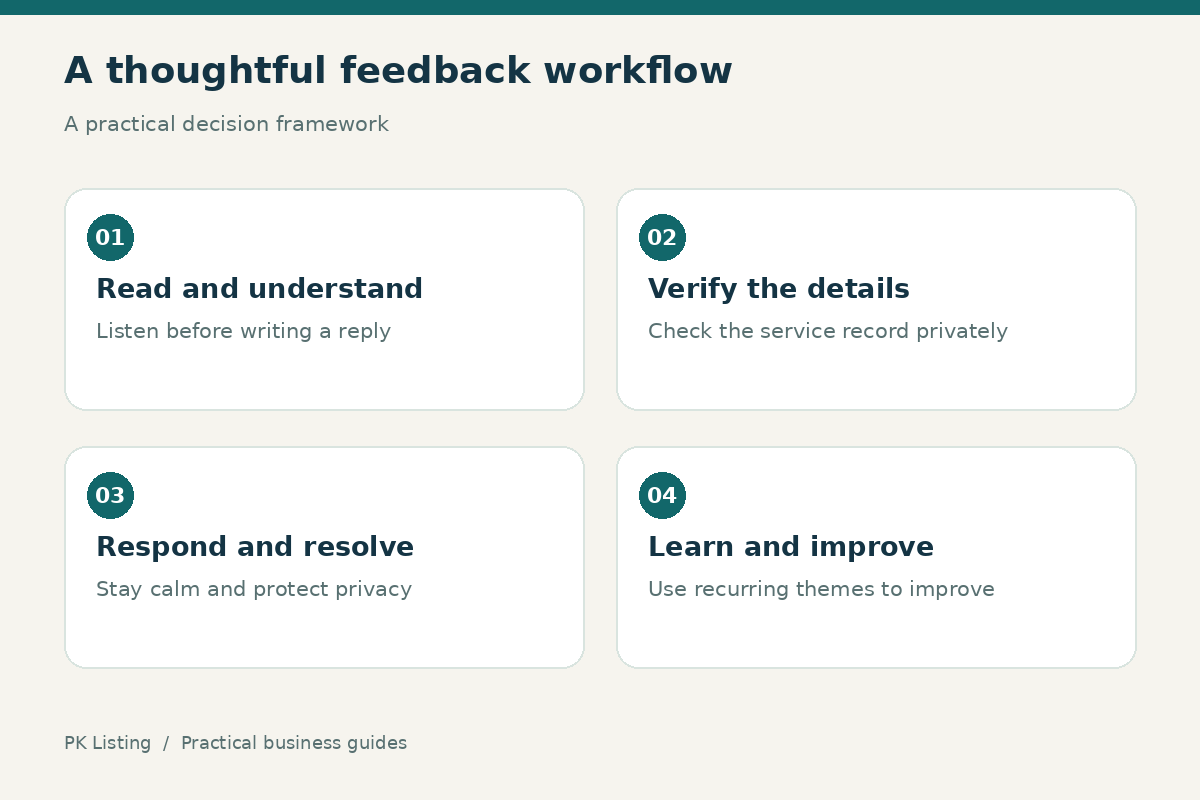
Do not answer an upsetting review immediately while emotions are high. Check the relevant service record, ask the team what occurred and distinguish confirmed facts from assumptions. Where the reviewer cannot be identified, say so neutrally rather than accusing them of dishonesty.
We’re sorry to hear that the visit did not meet your expectations. We would like to check the details and understand what happened. Please contact our team through the contact details on our website so we can review the matter privately.
Adapt this example to the actual situation. If you have confirmed a mistake, acknowledge it plainly and explain the next step you can genuinely take. Do not promise refunds, replacements or compensation publicly unless you are authorised to offer them.
If a review appears to violate a platform rule, use its reporting process and provide relevant evidence. A negative opinion is not automatically a policy violation. Continue handling the underlying service issue even if the platform does not remove the review.
6. Turn recurring feedback into operational changes
Keep a small internal tracker with the review date, topic, responsible person, action and completion status. Useful topics include appointment timing, quote clarity, staff communication, quality checks and after-service support. Avoid storing more personal information than you need.
Suppose several customers praise the work but mention uncertain arrival times. The useful response is not simply a warmer apology template. Review how arrival windows are communicated, who informs customers about delays and whether staff know when to escalate a scheduling problem.
Discuss patterns regularly and choose one improvement that can be checked. Record whether the change was introduced and whether similar concerns continue. Do not invent satisfaction percentages from a small or incomplete collection of public comments.
7. Keep your listing consistent with the experience
Reviews sometimes expose a mismatch between a listing and the actual service. If the profile implies weekend availability but your team does not offer it, correct the profile. If readers misunderstand what a package includes, make the exclusions clearer before another customer books.
Review your category and contact details using PK Listing’s business categories, then inspect the relevant business listing. Honest descriptions, useful pictures and a practical contact route support the review process. A reputation is strengthened by doing what the profile promises, not by collecting praise at any cost.