
Local SEO for UAE Small Businesses: A Practical Four-Week Action Plan
Local SEO for UAE small businesses is not a competition to repeat “Dubai” or “Abu Dhabi” as often as possible. The useful question is simpler: can the right customer find accurate information, understand your offer and contact you without friction?
This four-week plan is designed for a business owner or small team. It prioritises work you can inspect and measure, rather than promising a first-page position. Google says local results depend on relevance, distance and prominence, and there is no option to pay Google for a better organic local ranking. Read its official local-ranking guidance for the underlying principles.
Before you start: choose one meaningful goal
Pick a business result, not a vanity target. Examples include more suitable enquiries for commercial cleaning, fewer calls from outside your service area or more appointment requests for a particular service. Write the goal in ordinary language and choose the pages that support it.
Record your starting position: which pages exist, whether contact links work, common customer questions and the number of relevant enquiries you received in a comparable period. If you have Search Console access, retain the date range used for reports. Missing measurement is not the same as zero traffic.
Week 1: fix the information customers rely on
List your website, business profile, major social accounts and directory entries. Compare the public name, phone, location or coverage area, hours and website URL. Correct genuine contradictions. Do not change an established brand name just to insert search phrases.
Then test the whole enquiry route. On a phone, open the homepage, locate the relevant service, tap the contact button and check what happens. Does a call go to the intended number? Does the form tell people what happens next? Is the location clear before the customer has to type a message?
Use PK Listing’s categories to review how your service is described in a directory context. Your category should be recognisable to customers, not an internal department label. Keep actual service coverage clear rather than listing every emirate as a keyword. Our UAE business directory listing checklist provides a practical profile review.

Week 2: improve one important service page
Choose a service that matters commercially and that your team can explain well. Write a page around a real customer decision. Cover what is included, who the service suits, important limitations, the quotation process and preparation requirements. A useful page should reduce uncertainty before a call.
For a fictional office-maintenance provider, useful questions might include: can work happen outside office hours, what information is needed for a site visit, who coordinates access and how are extra tasks approved? The answers should reflect actual operating procedures, not promises copied from competitors.
Give the page a clear title, one main heading and descriptive subheadings. Include relevant pictures with accurate descriptions. Google’s Search Essentials recommends people-first content, understandable wording and crawlable links. Treat those as a foundation, not a formula for guaranteed results.
Avoid producing near-identical pages for dozens of neighbourhoods. A location page earns its place when it offers genuinely distinct information, such as a real branch, different availability or specific access guidance. Swapping only the place name adds little value for a reader.
Week 3: add evidence and useful connections
Review whether the site supports its claims. Replace vague “industry-leading” language with verifiable detail where available: the actual service process, team responsibilities, a genuine case example or a clearly explained quality check. Do not publish certifications, years of experience or customer outcomes that you cannot substantiate.
Link related pages naturally. A service page can link to its preparation checklist. A checklist can link back to the service explanation. Use wording that tells readers what they will find, such as “how to prepare for the appointment,” rather than repeated “click here” links.
Check relevant directory entries as well. Browse PK Listing’s business listings and assess your profile as a prospective customer would. Keep the website destination correct, use your own images and avoid creating duplicate entries for the same operation simply to gain more exposure.
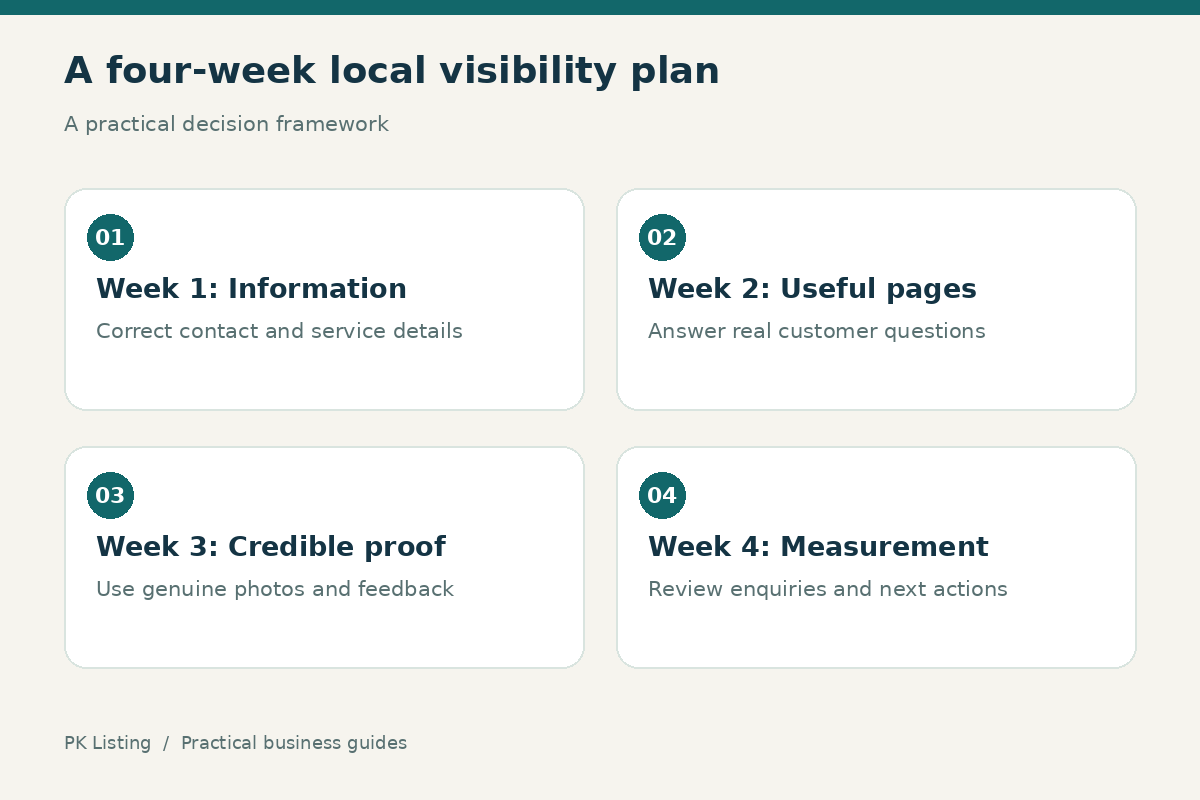
Week 4: measure and choose the next improvement
Compare the same length of time before and after the work, while noting holidays, promotions and other factors that could influence demand. Look at qualified enquiries and bookings alongside search data. A rise in page views without relevant enquiries may indicate that the page attracts the wrong audience or leaves an important question unanswered.
Use a lightweight improvement log: date, page changed, reason, result observed and next review date. Do not attribute every new enquiry to SEO. Ask customers how they found you, and record uncertainty rather than forcing every response into a preferred channel.
A monthly scorecard your team can maintain
- Accuracy: are hours, phone numbers and service areas current?
- Usability: can mobile visitors complete the intended enquiry step?
- Relevance: do enquiries match your services and coverage?
- Content: which recurring customer question still lacks a clear answer?
- Evidence: are claims, images and examples genuine and up to date?
Assign an owner to each issue rather than creating a long list nobody revisits. For a small team, completing one important correction each week is a more realistic operating habit than commissioning a large content batch and never maintaining it.
What this plan cannot promise
Neither a directory entry nor a four-week checklist guarantees indexing, rankings or revenue. Google’s SEO Starter Guide explains that search changes can take varying amounts of time to appear. The immediate outcome to aim for is a clearer, more trustworthy customer journey, with measurement that helps you decide what to improve next.